Model your UI with Ash. No more parallel vocabularies for the business domain and your UI.
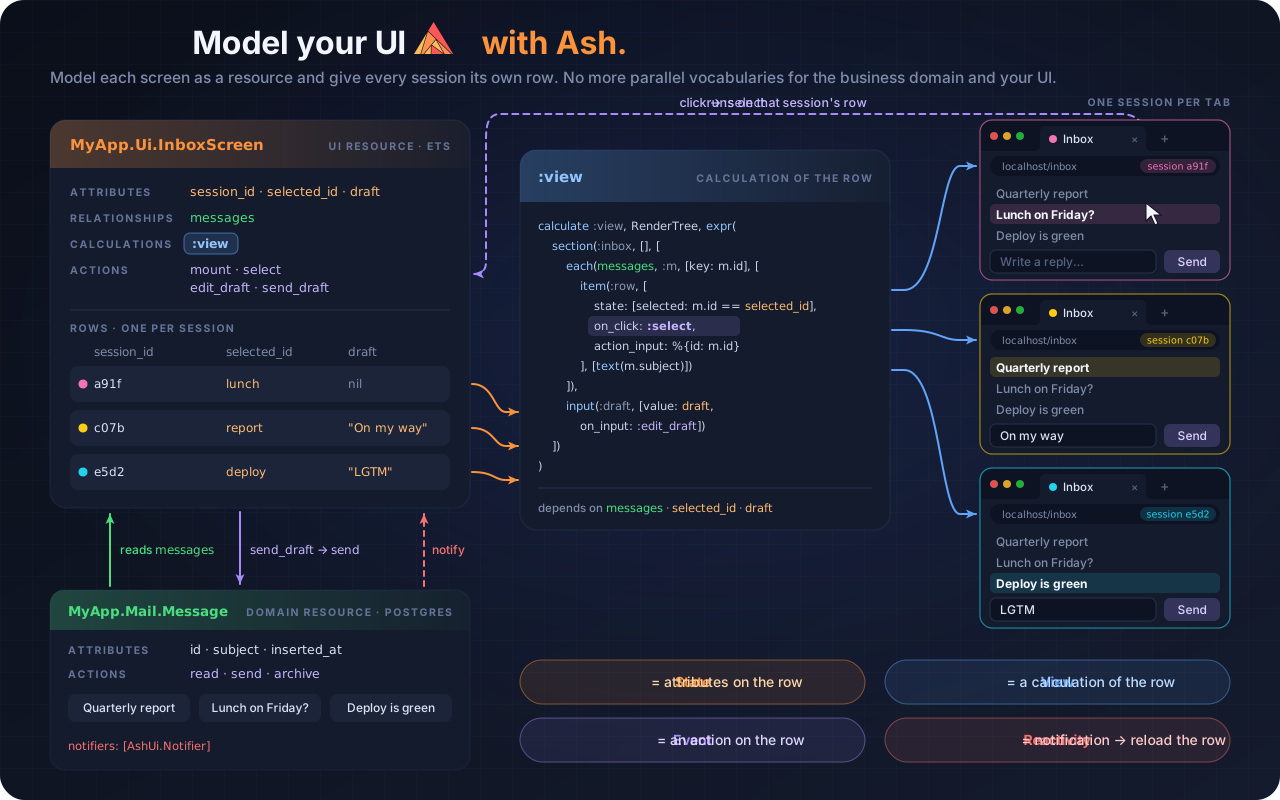
With AshUi you build user interfaces out of ordinary Ash resources.
You already have every part of a UI model in Ash. You give a resource typed state, identity, relationships to the data you want to show, calculations that derive values, actions that change state under validations and policies, and notifications for when something changes. With AshUi, one idea is added: you model a screen as a resource, and you give each browser session its own row. You get everything else from that idea.
- You keep the screen's UI state (selection, draft text, open panels, sort order) in the row's attributes.
- You load the data on screen through the row's relationships, aggregates, and calculations.
- You write the view as the row's
:viewcalculation. - Your users trigger the row's actions when they click, type, or submit.
- When someone changes a related record, we reload the row and recalculate the view for every user looking at it.
You don't learn a component system, a template language, a store, an
event-handler layer, or any subscription wiring. You write Ash resources, and
you keep using the tools you already use on Ash resources: policies, code
interfaces, Ash.calculate/3, tests, and introspection.
A screen
defmodule MyApp.Ui.InboxScreen do
  use Ash.Resource,
    domain: MyApp.Ui,
    data_layer: Ash.DataLayer.Ets,
    extensions: [AshUi],
    authorizers: [Ash.Policy.Authorizer]

  ets do
    private? false
  end

  ash_ui do
    stylesheets ["priv/static/inbox.css"]
  end

  routes do
    route "/inbox"
  end

  policies do
    policy always() do
      authorize_if actor_present()
    end
  end

  # You get one row per browser session; we fill in session_id.
  attributes do
    attribute :session_id, :uuid, allow_nil?: false, primary_key?: true
    attribute :selected_id, :uuid, public?: true
    attribute :draft, :string, public?: true
  end

  identities do
    identity :session_instance, [:session_id]
  end

  # You declare what the screen shows; we subscribe the screen to it.
  relationships do
    has_many :messages, MyApp.Mail.Message do
      no_attributes? true
      sort inserted_at: :desc
    end
  end

  # You write the view as a calculation of the row.
  calculations do
    calculate :view, AshUi.Type.RenderTree, expr(
      section(:inbox, [], [
        list(:messages, [], [
          each(messages, :message, [key: message.id], [
            item(:message_row,
              [state: [selected: message.id == selected_id],
               on_click: :select,
               action_input: %{id: message.id}],
              [text(message.subject)])
          ])
        ]),
        form(:composer, [on_submit: :send_draft], [
          input(:draft_input,
            [value: draft,
             on_input: :edit_draft,
             action_input: %{draft: event(:value)}],
            []),
          button(:send, [type: :submit], [text("Send")])
        ])
      ])
    )
  end

  # Your users trigger these actions from the view.
  actions do
    defaults [:read]

    create :mount

    update :select do
      argument :id, :uuid, allow_nil?: false
      change set_attribute(:selected_id, arg(:id))
    end

    update :edit_draft do
      accept [:draft]
    end

    update :send_draft do
      require_atomic? false
      validate present(:draft)

      change fn changeset, context ->
        Ash.Changeset.before_action(changeset, fn changeset ->
          MyApp.Mail.send_message!(changeset.data.draft, scope: context)
          Ash.Changeset.force_change_attribute(changeset, :draft, nil)
        end)
      end
    end
  end
end
You add one line to the domain resource so that we can refresh the screens that read it:
defmodule MyApp.Mail.Message do
  use Ash.Resource,
    domain: MyApp.Mail,
    data_layer: AshPostgres.DataLayer,
    notifiers: [AshUi.Notifier]

  # ...
end
This example is compiled and run in test/readme_example_test.exs.
What you get from "a screen is a resource"
You can see and test all UI state. You declare UI state as typed attributes on a row, so you read it, query it, and test it like any other Ash data. You choose between a stored row and an embedded value for storage reasons only; you don't change any behaviour by switching.
You render under your policies. You call
Ash.calculate(screen, :view, actor: actor) and get the same render tree
your users' browsers get. You decide what each actor can see with the same
actor, tenant, and policy rules you already use for queries.
You find event mistakes at compile time. You name an action with
on_click: :select, and we check at compile time that the resource
declaring the binding has that action. We also check every action_input
field and event(:value) marker against the action's arguments. At runtime
you get the action's own casts, validations, changes, and policies, and your
users see each error next to the field bound to it.
You write no reactivity wiring. You declare a relationship to load the messages, and we use the same declaration to decide which notifications concern the screen. When someone commits a write, we reload the row through its relationships as the session's actor and recalculate the view. We treat a notification only as a hint to reload; we rely on the reload for correctness.
You ship small patches. We compile your view calculation into a patch table and record which attributes and relationships each part of it reads. When something changes, we re-evaluate only the slots that read it, and we diff lists per keyed entry. With the Phoenix adapter, we send standard LiveView diffs.
You compose by function application. You place another resource's view
with render(Child, input). You pass markup as a value in an attribute of
type AshUi.Type.RenderTree. You don't need slots, emits, or callbacks.
You get the URL from the row. You bind route path and query parameters to the mount action's arguments by name. When your actions change those attributes, we update the browser location to match.
Installation
def deps do
  [
    {:ash_ui, "~> 0.1.0"},
    {:ash_ui_phoenix, "~> 0.1.0"}
  ]
end
The view helpers are implemented as Ash custom expressions, which are read
from your application's config at compile time, so list them there. Keep your list identical to AshUi.Expressions.canonical/0:
config :ash,
  custom_expressions: [
    AshUi.Expressions.ToString,
    AshUi.Expressions.Humanize,
    AshUi.Expressions.RelativeTime,
    AshUi.Expressions.TimeAgoInWords,
    AshUi.Expressions.Truncate,
    AshUi.Expressions.StripPrefix,
    AshUi.Expressions.ClassJoin,
    AshUi.Expressions.Blank,
    AshUi.Expressions.Present,
    AshUi.Expressions.Empty,
    AshUi.Expressions.NilifBlank,
    AshUi.Expressions.Join,
    AshUi.Expressions.Count,
    AshUi.Expressions.SortBy,
    AshUi.Expressions.AppendUnique,
    AshUi.Expressions.FindBy,
    AshUi.Expressions.FieldErrors,
    AshUi.Expressions.Default
  ]
With Phoenix, mount every routed screen in a domain from your router:
defmodule MyAppWeb.Router do
  use AshUi.Phoenix.Router, presets: []

  ash_ui_browser_pipeline()

  scope "/" do
    pipe_through :browser
    ash_ui_routes domains: [MyApp.Ui]
  end
end
Then serve the client runtime from your endpoint with
plug AshUi.Phoenix.Assets. You keep your endpoint, sessions,
authentication, and PubSub. We supply the mount, dispatch, and render path.
Packages
| Package | Purpose |
|---|---|
ash_ui | The Ash extension: view constructors, compile-time verification, patch tables, the differential render kernel, notifications, sessions, static HTML, theming |
ash_ui_phoenix | Phoenix LiveView adapter: router, mount, dispatch, notification reloads, assets |
ash_ui_datastar | Plug and Server-Sent Events adapter for Datastar |
We keep every render target out of the core. We build each adapter on the same compiled artifacts.
Design
Read DESIGN.md for the full contract: sessions, the view calculation, events, reactivity, the renderer, routing, theming, and current limitations.
Status
We have released AshUi 0.1. We consider the authoring model stable. Expect us to change the adapter APIs and some theming details before 1.0. We dispatch notifications on a single node only.
License
Apache License, Version 2.0. See LICENSE and NOTICE. We
derived the render and diff algebra in lib/ash_ui/diff.ex and
lib/ash_ui/rendered.ex from Phoenix LiveView, under its MIT license, which
is reproduced in NOTICE.